New York Construction Report staff writer
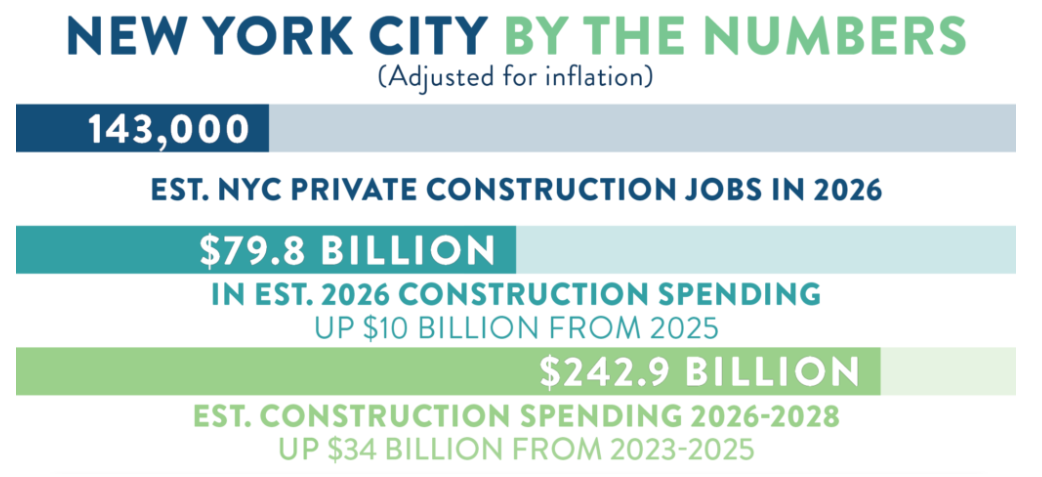
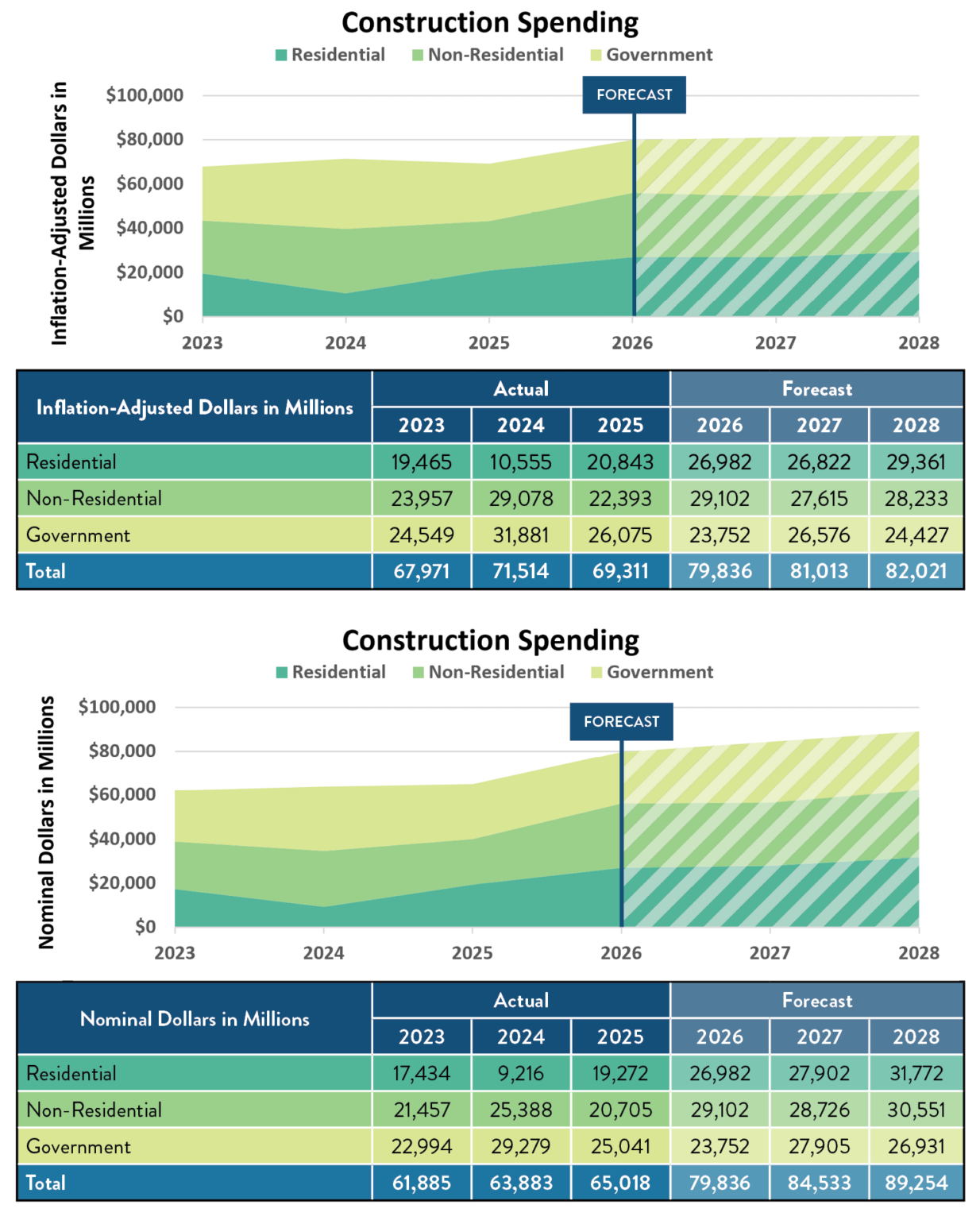
New York City construction spending is forecast to reach $79.8 billion by the end of 2026, a $10 billion increase from the previous year after adjusting for inflation, according to the New York Building Congress.
The forecast represents a 15 per cent increase in inflation-adjusted spending compared with 2025 and points to continued growth across the city’s construction industry despite high interest rates, rising material costs, tariff uncertainty and federal policy concerns.
The Building Congress projects inflation-adjusted construction spending will total $242.9 billion between 2026 and 2028. Annual spending is expected to reach approximately $81 billion in 2027 and $82 billion in 2028.
In nominal dollars, which do not account for inflation, total construction spending is forecast to rise from $79.8 billion in 2026 to $84.5 billion in 2027 and $89 billion in 2028.
 Compared with the previous three-year period, from 2023 to 2025, inflation-adjusted spending is expected to increase 16 per cent, while nominal spending is projected to rise 33 per cent.
Residential construction, entertainment and recreational facilities, educational buildings and government service buildings are expected to record some of the strongest year-over-year growth in 2026.
The city’s construction industry is also expected to expand its physical output. After recording 37 million gross square feet of construction in 2025, the Building Congress forecasts more than 57 million square feet this year, increasing to 59 million in 2027 and 63 million in 2028.
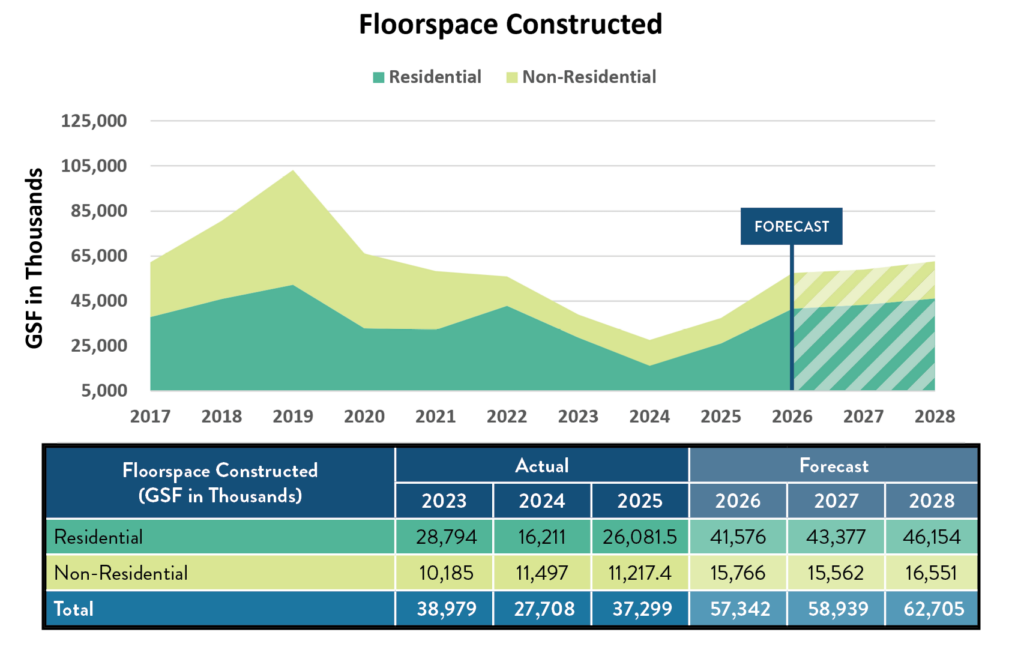 Residential development will account for approximately 72 per cent of the floorspace forecast for 2026. The growth is being driven primarily by new projects, including large residential buildings in rezoned areas, although office-to-residential conversions and other renovation work remain significant.
The residential sector is forecast to see inflation-adjusted spending increase 64 per cent over the 2026-2028 period compared with the previous three years, representing an increase of approximately $32 billion.
Building permits are expected to be issued for about 31,500 new housing units in 2026, significantly above the annual average of approximately 20,000 units constructed between 2020 and 2025.
The Building Congress attributes the increase to large-scale rezonings in neighbourhoods such as Gowanus, Long Island City and Midtown South, as well as the city’s City of Yes initiative, which reduces zoning restrictions on small and medium-sized developments.
 Office-to-residential conversions are also contributing to housing production. The report identifies increased floor-area ratio allowances following rezonings, particularly in Midtown, as an important factor supporting these projects.
Residential construction costs have increased, with the average cost per unit rising from $174,000 in 2025 to $184,700 in 2026. Including renovations, residential construction spending is expected to reach approximately $27 billion this year.
Non-residential construction spending, which includes offices, manufacturing facilities, retail, hotels, educational buildings, health-care facilities and entertainment venues, is forecast to reach $29 billion in 2026. That represents an increase of more than $6.7 billion from 2025.
 Several major projects are expected to contribute to growth in the sector.
Casino development is expected to generate substantial construction activity, with three licensed projects representing approximately $17.6 billion in planned investment. They include the $8.1-billion Hard Rock Metropolitan Park near Citi Field, the $5.5-billion Resorts World expansion at Aqueduct and the $4-billion Bally’s Bronx development at Ferry Point.
Government service building construction is also expected to increase as work advances on New York City’s Borough-Based Jails program, which will replace the Rikers Island jail complex with four facilities.
The Department of Design and Construction lists awarded design-build contracts of approximately $2.95 billion for the Brooklyn facility, $3.76 billion for Manhattan, $3.98 billion for Queens and $2.97 billion for The Bronx.
Educational construction is being supported by additional school capacity and modernization projects. The School Construction Authority’s proposed $20.97-billion capital plan for fiscal 2025-2029 includes new classrooms and major building improvements, including electrification.
Office construction is expected to remain active, although spending could ease slightly from its 2025 high. Major projects scheduled to begin in 2026 include American Express’s planned 2-million-square-foot headquarters at Two World Trade Center and a $1-billion office tower at 625 Madison Avenue.
Other projects include the $200-million redevelopment of 460 Park Avenue, the Citadel-anchored 350 Park Avenue and the redevelopment of the Grand Hyatt at 175 Park Avenue.
The Building Congress expects residential construction to overtake non-residential construction spending by 2028, reversing a pattern in which non-residential work has historically accounted for the larger share of investment.
Public infrastructure also remains a significant component of the city’s construction market, although government spending has declined since reaching a peak in 2024.
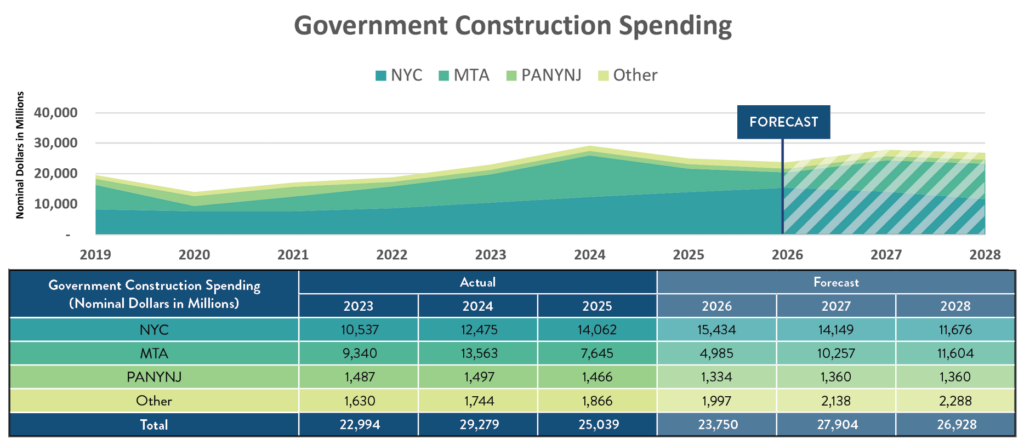
Capital spending by New York City and state governments, the Metropolitan Transportation Authority and the Port Authority of New York and New Jersey reached $32 billion in 2024. The Building Congress estimates that figure declined to $26 billion in 2025, with $23.8 billion budgeted for 2026.
Spending is forecast to increase to $26.6 billion in 2027 before declining to $24 billion in 2028.
The MTA is expected to invest approximately $27 billion in nominal dollars within the five boroughs over the next three years as it advances its 2025-2029 capital plan.
The plan includes signal modernization, accessibility improvements, rehabilitation of existing infrastructure, the second phase of the Second Avenue Subway and the proposed Interborough Express.
The MTA’s annual spending on transit and bus systems, Metro-North and Long Island Rail Road facilities, and bridges and tunnels is expected to increase from $7.7 billion in 2025 to $10.4 billion by 2027.
The Port Authority is forecast to invest $1.3 billion in New York City capital projects in 2026. Its upcoming work includes the new $11-billion Midtown Bus Terminal, which is expected to become a major contributor to construction activity during the 2026-2028 forecast period.
New York City itself is expected to spend $15 billion on construction and design across 72 municipal infrastructure categories in fiscal 2026. The largest allocations include $3.5 billion for Housing Preservation and Development, $3.3 billion for education and $867 million for water pollution control.
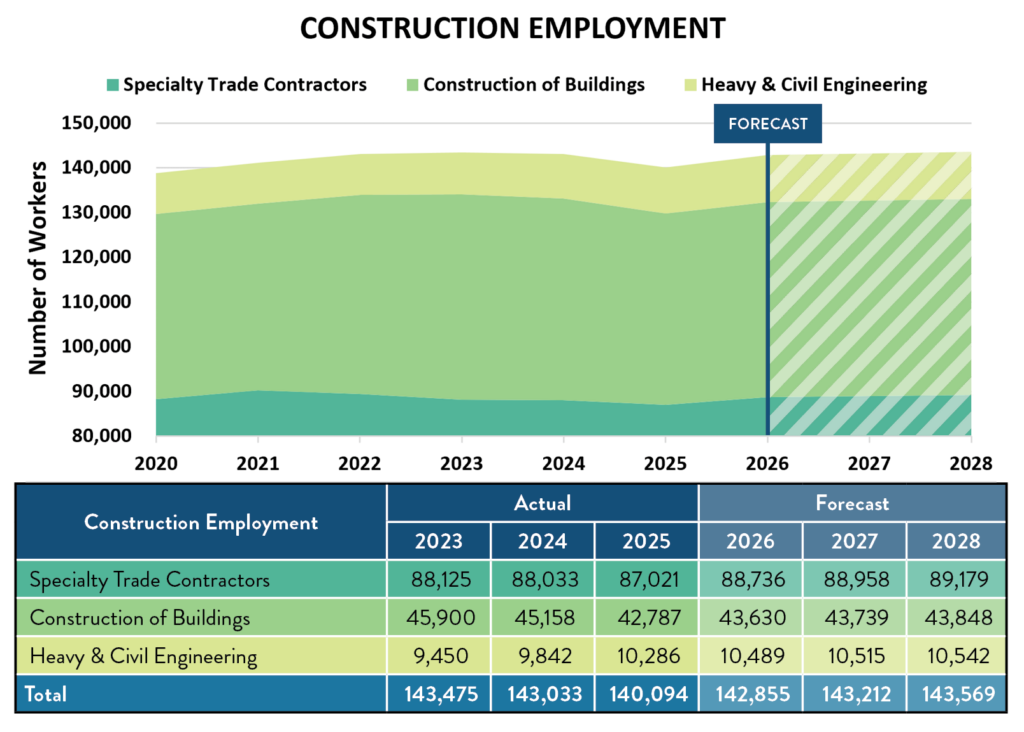
Employment in the private construction sector is also expected to increase modestly. The Building Congress forecasts 142,855 jobs in building construction, heavy and civil engineering, and specialty trades in 2026, rising to 143,212 in 2027 and 143,569 in 2028.
The 2026 forecast represents an increase of more than 2,700 jobs from 2025.
However, the number of construction jobs supported by each $1 million in spending has declined as project costs have risen. The average fell from 2.7 jobs between 2017 and 2019 to 1.8 jobs in 2026.
The Building Congress said continued growth will depend partly on stable government capital budgets, federal infrastructure funding and improvements to project delivery and approval processes.
Among its recommendations, the organization is calling for a federal surface transportation reauthorization through the proposed Build America 250 Act, expanded development incentives through the 485-x tax program, streamlined permitting and environmental reviews, and additional investment in workforce training.
It is also urging governments to maintain infrastructure spending, improve procurement practices and support investment in energy infrastructure and grid capacity.
The report notes that New York City has accounted for approximately 3 per cent of total U.S. construction spending annually over the past five years, underscoring the city’s importance to the national construction industry.