New York Construction Report staff writer
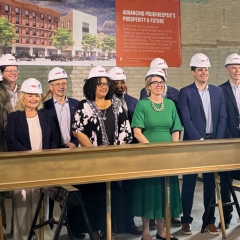
Construction has started on Wallace Campus, a $147 million mixed-use affordable housing development that will bring 187 units to the City of Poughkeepsie while redeveloping a long-vacant former department store on Main Street in Dutchess County.
The project is part of a broader effort by state housing agencies and development partners to expand housing supply in the Hudson Valley and convert underused downtown buildings into residential and commercial space.
New York State Homes and Community Renewal reports it has created or preserved more than 9,000 affordable homes in the Hudson Valley, including over 1,000 in Dutchess County. Wallace Campus is part of the state’s five-year housing plan aimed at creating or preserving 100,000 affordable homes statewide.
The development is being built by Mega Development Group and Ametrine Group in partnership with Mental Health America of Dutchess County, which will provide on-site supportive services.
Wallace Campus will convert the former Wallace Department Store into 69 apartments and add 118 new units across two newly constructed buildings. Units will include studios and one-, two- and three-bedroom apartments affordable to households earning up to 80% of area median income.
Of the total units, 30 will be designated as supportive housing with services that include care coordination, community education and family support programs. The project also includes more than 22,000 square feet of ground-floor commercial retail space across the three buildings, maintaining the site’s historic commercial use and supporting downtown revitalization efforts.
The property is located at Main and Catharine streets, within walking distance of the Poughkeepsie Metro-North station, local transit routes, and municipal and commercial services.
Originally constructed in the 1870s, the Wallace Department Store was once a major retail destination before closing in the 1970s. The building has been vacant since 2022.
Plans call for preservation of key historic features, including the limestone façade, original stairways and an ornate dome ceiling on the fourth floor, while integrating new residential construction.
The site is enrolled in New York’s Brownfield Cleanup Program, allowing environmental remediation as part of redevelopment. Amenities will include a fitness center, co-working space, game room, study hall, movie screening room and bike storage in each building. Outdoor improvements will include landscaped walkways, seating areas, green space and a children’s play area called Wallace Green.
Two buildings will include wraparound ground-floor windows intended to connect indoor residential space with outdoor public areas.
All units will be fully accessible or adaptable, including 11 units designed for residents with mobility impairments and five for residents with sensory disabilities. The development will be fully electric and include ENERGY STAR appliances, low-flow plumbing fixtures and energy-efficient lighting systems.
Financing includes federal and state Low-Income Housing Tax Credit programs administered by New York State Homes and Community Renewal, expected to generate a combined $58.9 million in equity.
Additional funding includes $38 million from the Supportive Housing Opportunity Program, $5 million from the Middle-Income Housing Program and $2 million from the Rural and Urban Community Investment Fund.
The project also includes $1.4 million in clean energy funding through a partnership with the New York State Energy Research and Development Authority, $750,000 from Empire State Development’s Regional Council Capital Fund Program, $2.2 million from the Dutchess County Housing Trust Fund and $540,000 from the HOME Investment Partnership Program.
Historic preservation funding includes about $8 million in federal historic tax credits and $5 million in state historic tax credits.
Officials said the project is part of a broader push to expand housing production and encourage adaptive reuse of aging buildings in transit-accessible downtown areas, while supporting construction activity and long-term housing supply goals.