New York Construction Report staff writer
Governor Kathy Hochul on Tuesday unveiled a FY27 Budget infrastructure plan aimed at accelerating housing construction, modernizing water systems, and upgrading transportation networks across New York State.
The final budget includes record capital funding for housing production, water infrastructure, and local public works, alongside targeted investments in transit modernization and large-scale planning projects intended to reduce congestion and shorten commute times.
“With this budget, we are on track to reestablish New York’s position as a leader in building world-class infrastructure,” Hochul said. “These investments are key to making New York more affordable and livable and creating economic opportunity for New Yorkers for generations to come.”
At the center of the FY27 plan is more than $850 million in new housing capital funding aimed at accelerating development timelines and expanding production capacity across both public and private sectors.
$250 million is allocated to speed up affordable housing construction, with officials framing the investment as a way to move projects from planning to shovel-ready status more quickly. Another $100 million is directed toward expanding the MOVE-IN NY program, which supports modular and factory-built construction methods that can reduce on-site labor time and overall project costs.
Public housing and preservation efforts also receive significant support, including $140 million for capital repairs at New York City Housing Authority (NYCHA) developments and $75 million for housing authorities outside the city. An additional $85 million will go toward preserving Mitchell-Lama developments statewide.
Other construction-related housing initiatives include $50 million for land bank expansion, $40 million to rehabilitate vacant rental units outside New York City, and $30 million for infill development of small homes.
A $6 million revolving loan fund will support manufactured home park infrastructure upgrades, while $20 million is earmarked for lead abatement projects tied to housing safety compliance.
Water infrastructure tied directly to housing growth
Water and sewer capacity remains a limiting factor for new construction in many communities, particularly outside major urban centers.
The FY27 budget includes a five-year, $3.75 billion water infrastructure commitment, with $750 million deployed in the current cycle. The funding will support upgrades to aging sewer systems, drinking water treatment facilities, and lead service line replacement programs.
A new Smart Growth Water Grant Program will prioritize projects that directly enable housing expansion, including sewer and water systems that unlock new development sites.
For contractors and heavy civil firms, the program is expected to generate sustained bid opportunities across municipal water and wastewater upgrades statewide.
Parks, public facilities, and community construction
The budget also expands investment in civic infrastructure projects, including $75 million for construction of High Falls State Park in Rochester, which will redevelop 40 acres of former brownfield land into public park space.
New park capital funding will support upgrades at Denny Farrell Riverbank State Park, Montauk Downs State Park, and Lake Welch Beach.
A separate $75 million round of NY BRICKS funding will support the construction and renovation of community centers statewide, continuing a program focused on recreation and public-use facilities.
Transportation megaproject design and planning funding
A $50 million allocation will fund design work for a reimagined Jamaica Station in Queens, one of the busiest commuter rail hubs in North America. The project aims to improve passenger flow and integrate connections between the Long Island Rail Road, subway service, and JFK Airport transit.
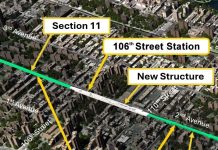
Another $25 million will support design and preliminary engineering for a proposed extension of the Second Avenue Subway westward along 125th Street, advancing tunneling and environmental review work.
Officials say these early investments are intended to reduce future construction delays and improve cost efficiency by completing planning and sequencing work in advance.