New York Construction Report staff writer
Construction is set to begin in late April on a major reconstruction of Flatbush Avenue in Brooklyn, a multi-phase infrastructure project designed to improve bus performance, enhance safety and modernize one of the borough’s most heavily used corridors.
The New York City Department of Transportation (NYC DOT) will resume installation of center-running bus lanes between Livingston Street and Grand Army Plaza, alongside roadway reconstruction, pedestrian upgrades and utility coordination work. Construction is expected to improve travel times for more than 130,000 daily bus riders.
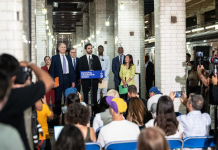
Mayor Zohran Kwame Mamdani said the project reflects a shift toward transit-priority infrastructure in a corridor where bus reliability has long been a challenge.
“These center-running bus lanes will give New Yorkers back something precious: time with their families, time at work, time in their communities,” Mamdani said. “Long waits and unreliable service are not inevitable — they are the result of political choices.”
The redesign will include transit and safety improvements as part of a broader reconstruction of the avenue.
The scope of work includes full roadway reconstruction, installation of dedicated bus lanes, new loading zones, upgraded traffic signals, pedestrian safety enhancements and 29,000 square feet of additional pedestrian space. Construction is expected to continue through fall 2026.
Work will be completed in four phases, with traffic maintained in both directions throughout construction through staged lane shifts and partial roadway reconstruction. Initial work includes removal of two concrete pedestrian islands at Flatbush Avenue and Atlantic Avenue, followed by alternating reconstruction of each side of the corridor.
NYC DOT said the staging plan is designed to keep the corridor operational while limiting full closures, with temporary markings, rerouted bus stops and protected work zones in place throughout construction.
The Flatbush Avenue project is one of several recent corridor reconstructions in New York City focused on bus priority and multimodal safety improvements. The agency cited previous work on 161st Street in the Bronx and Edward L. Grant Highway as examples of similar designs that delivered measurable improvements in bus speeds and safety outcomes.
City officials say the project is part of a broader effort to modernize aging street infrastructure while improving transit reliability in high-demand corridors across Brooklyn.