New York Construction Report staff writer
The Metropolitan Transportation Authority (MTA) is moving forward with design and environmental review for the $5.5-billion Interborough Express (IBX), while also bringing accessibility upgrades to four existing subway stations that will connect with the planned Brooklyn-Queens light rail line.
The accessibility projects are intended to ensure that all 18 IBX stations will be fully accessible, with connections to 17 subway lines and the Long Island Rail Road.
The IBX is in its design and engineering phase, launched by Gov. Kathy Hochul last August. The project is expected to serve about 160,000 daily riders and improve transit connections for more than 900,000 residents in historically underserved communities across Brooklyn and Queens.
Three subway stations are already undergoing accessibility improvements that are scheduled to be completed before the IBX opens.
At Broadway Junction, accessibility improvements serving the A, C, J, Z and L lines are being funded through the MTA’s 2020-24 Capital Plan and are expected to be completed by the end of 2027.
At Junius Street on the 3 line, the MTA is delivering an accessible station along with a new connection to the Livonia Avenue L station. The work is also funded through the 2020-24 Capital Plan and is expected to be completed by the end of 2026.
Accessibility improvements at Avenue I on the F line are expected to be completed in early 2028 under the same capital plan.
The MTA has also brought forward accessibility improvements at Wilson Avenue on the L line through its 2025-29 Capital Plan. A construction contract is expected to be awarded by mid-2027, making Wilson Avenue the final IBX-subway transfer station to receive accessibility improvements.
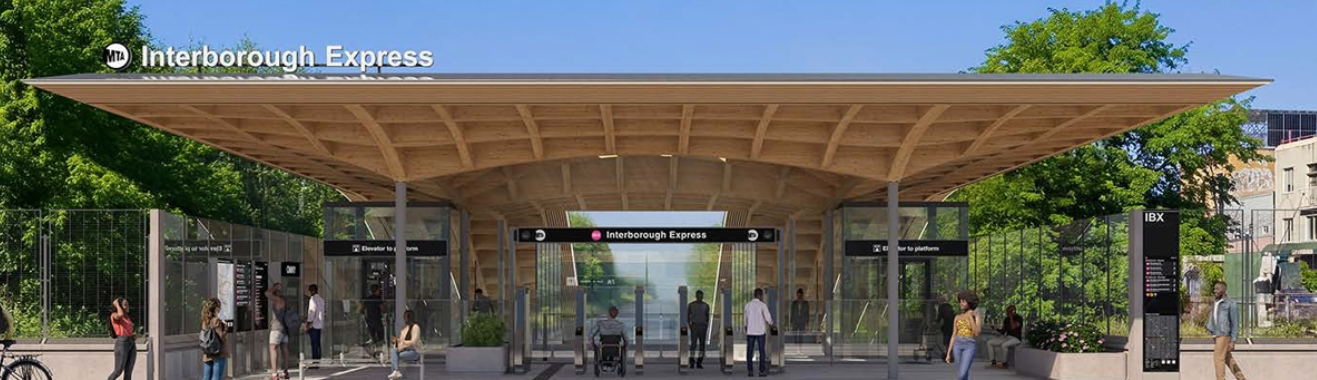
All 18 new IBX stations will incorporate universal design principles. Planned features include clear sightlines, tactile floor tiles leading to wide fare gates, pass-through elevators with wider cabs, level boarding, enhanced lighting, digital signage, audio announcements and accessible wayfinding.
“The Interborough Express will transform travel in Brooklyn and Queens, cutting commute times for more than 160,000 daily riders,” said MTA Construction & Development President Jamie Torres-Springer. “From day one, we’re building accessibility into every aspect of the project because every rider should be able to take full advantage of this new way to move across the boroughs.”
The MTA also plans to release the IBX Draft Environmental Impact Statement (DEIS) in the fourth quarter of this year, ahead of schedule.
The DEIS will mark a major milestone for the project and will be followed by public meetings where residents of Brooklyn and Queens can comment on the plans.
The project team has held nearly 30 pop-up events this summer, generating more than 7,000 community engagements. About 140 public events have been held along the IBX corridor to date.
In the spring, the project team met with all 14 community boards along the corridor and held public workshops focused on the project’s design. More than 425 people participated in the workshops, providing about 6,000 feedback responses.
The IBX is planned as a new transit connection between Brooklyn and Queens, with the MTA projecting significantly shorter travel times for residents along the corridor.